

Engaging Communities in Addressing Substance Use (ECASU)- SOR 4.0 YR 3 Solicitation
DSAMH State Opioid Response (SOR) 4.0 Grant Year 3
Tier Award Program
Engaging Communities in Addressing Substance Use (ECASU)
Released: September 28, 2026
About This Solicitation
Starting this year, the Engaging Communities in Addressing Substance Use (ECASU) initiative offers three different opportunities to engage with DSAMH during SOR 4.0 Year 3, with project start dates in early 2027. Applicants are encouraged to review and compare the opportunities described in this solicitation to determine which opportunity best aligns with their proposed project, organizational capacity, and support or funding needs.
ECASU offers the following opportunities:
- Community Awareness Partnerships
- Messaging Campaigns
- Mini-Grants
Questions and completed applications should be submitted to DSAMH.ORT@delaware.gov.
- Overview
The Delaware Division of Substance Abuse and Mental Health (DSAMH) recognizes the need to leverage local community expertise to reach and impact the wide array of communities that continue to be impacted by the opioid overdose crisis. DSAMH also acknowledges that not all communities have been or are impacted equally. Although there have been recent improvements in drug overdose deaths, significant work remains. DSAMH is committed to offering multiple ways to partner with communities to prevent overdose, reduce the impact of opioid and stimulant use disorders, and improve access to prevention, treatment, and recovery services across Delaware.
Through the federal State Opioid Response (SOR) Grant, the Engaging Communities in Addressing Substance Use (ECASU) initiative offers three opportunities for organizations and community leaders working to address OUD/STUD in Delaware:
- Community Awareness Partnerships (ECASU-CP): Provides individualized technical assistance and implementation support from a communications vendor/partner to help organizations and community leaders develop and implement communication, education, and awareness initiatives. Selected Community Partners do not receive any direct funding.
- Messaging Campaigns (ECASU-MC): Provides direct grant funding to organizations to develop and implement community-based communication, education, and awareness campaigns to address substance use awareness or stigma among local communities.
- Mini-Grants (ECASU-MG): Provides direct funding for organizations to implement community-driven projects aligned with SOR and ECASU goals.
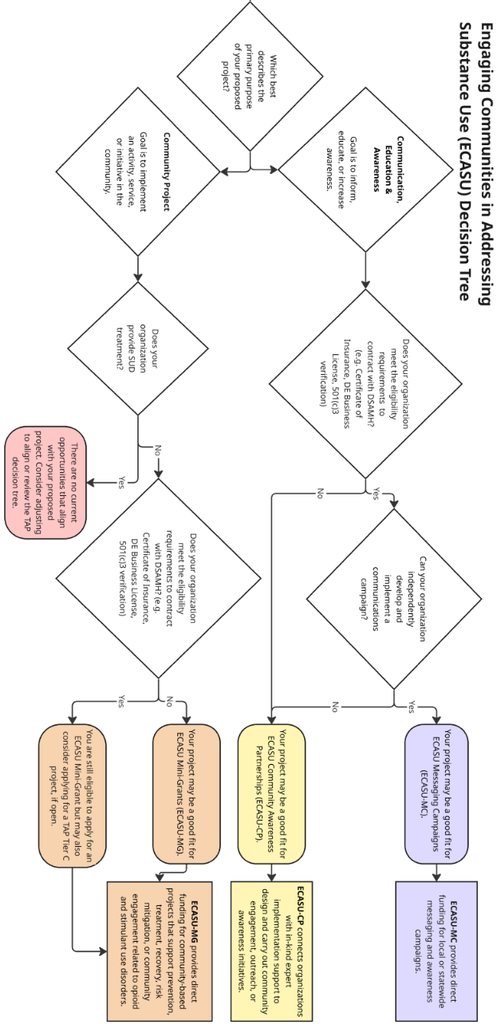
Each opportunity serves a different purpose and provides a different type and level of support. Applicants should review Section II and use the Applicant Decision Tree to identify the opportunity that best aligns with their proposed activities, organizational capacity, and support needs.
- Which ECASU Opportunity is Right for Me?
ECASU supports different types of community-based activities through varying combinations of funding, technical assistance, and implementation support. Prospective applicants should use the information below to identify the opportunity that best aligns with their proposed project.
DSAMH will host an informational webinar on Wednesday, October 7, 2026, from 11:00am – 12:00pm, to provide an overview of the three opportunities and answer any questions that prospective applicants may have. Register here: https://us06web.zoom.us/meeting/register/yPodcVtvTeWHKZ9fsEFcQg
- ECASU Opportunities at a Glance
| ECASU Opportunity | Best Fit If… | Support Provided |
| Community Awareness Partnerships (ECASU-CP) | You are seeking to develop and implement a communications, education, or awareness initiative, but would benefit from individualized, hands-on technical assistance and implementation support and/or are unable to meet the requirements to contract directly with DSAMH. | No direct funding. Individualized technical assistance, and hands-on implementation support and in-kind materials provided. |
| Messaging Campaigns (ECASU-MC) | You are seeking funding to develop and implement a communications, education, or awareness campaign focused on increasing awareness or reducing stigma related to OUD/STUD, and your organization has the capacity to meet DSAMH contracting requirements and independently manage and implement the funded campaign. | Direct funding (up to $50,000 for a statewide campaign; up to $30,000 for a local-level campaign). Limited technical assistance and implementation support. |
| Mini-Grants (ECASU-MG) | You are seeking funding for a community-driven project focused on strengthening local capacity, partnerships, engagement, or connections to substance use-related resources and services (not a communications or awareness campaign) aligned with SOR and ECASU goals. | Direct funding (up to $20,000). Optional technical assistance and implementation support available. |
- Applicant Decision Tree
Use the Applicant Decision Tree below for additional guidance in identifying the ECASU opportunity that may be the best fit for your proposed activities and support needs. Applicants are encouraged to review the program-specific requirements for the opportunity identified through the decision tree before completing an application.
- Ready to Apply?
Step 1: Use the table and decision tree above to identify the opportunity that best fits your project and organizational capacity.
Step 2: Review the requirements for that opportunity in this solicitation. Use the Table of Contents to quickly jump to the opportunity you are interested in.
Step 3: Download, carefully review, and complete the corresponding application material(s).
Step 4: Submit the completed application material(s) by November 6, 2026, at 5:00 p.m. EST to DSAMH.ORT@delaware.gov.
Below is an estimated timeline for application review, award processes, and implementation for projects. DSAMH reserves the right to amend the timeline, as needed.
- Solicitation Release: September 28, 2026
- Informational Webinar: October 7, 2026, from 11:00am – 12:00pm
- Application Deadline: November 6, 2026, by 5:00 pm EST
- Application Review: November/December 2026
- Award Selections: January 2027
- Projects Start:
- ECASU-CP: February 2027
- ECASU-MC: April 2027
- ECASU-MG: February 2027
- Projects End: September 29, 2027
- Community Awareness Partnerships (ECASU-CP)
- What is ECASU-CP?
ECASU-CP aims to work with a broad base of community-based organizations, community leaders, and healthcare providers who directly engage members of the community to educate, increase awareness, and provide resources for OUD/STUD. These strategies can include, but are not limited to, in-person events, educational sessions, social media strategies, video campaigns, and listening sessions.
Applicants will be asked to provide specific information on their current engagement with their local communities and their concrete strategies to engage in activities to reach individuals at risk of or experiencing OUD/STUD in these communities.
- Project Requirements
DSAMH will provide partners with access to a Campaign Planner, through its vendor partners Health Management Associates (HMA) and 720 Strategies, to assist in the design of a customized project plan (campaign plan), which will include key activities, timelines, and costs associated with implementing the campaign. All partnerships will include: 1) Support on project plan development, 2) Training and support to identify and achieve desired outcomes, and 3) Preparation for presenting at the Summit for Engaging Community Partners.
Below are the focus areas of DSAMH’s current campaign strategies, which require a focus on opioid and stimulant use, that can be supported by DSAMH and its technical assistance vendors for partners to refine and implement within their own communities. Refer to the application form for a full list of sample project activities.
- Reducing stigma toward persons with OUD/STUD
- Promoting awareness of and access to OUD/STUD treatment and recovery services
- Reducing stigma toward medications for opioid use disorders (MOUD), such as methadone and buprenorphine
- Promoting access to naloxone/Narcan
- Increasing awareness and knowledge of existing resources among local communities
Each community partner will be required to:
- Select a campaign focus area(s) and activities you are interested in implementing, any expected outcomes, and the location of the campaign event(s), if applicable.
- Participate in meetings with the Campaign Planner and DSAMH for technical assistance and develop a campaign plan.
- Participate in a virtual kickoff meeting in February/March 2027 with the full ECASU-CP cohort to review project expectations.
- Participate in a one-day, in-person networking event in April 2027 with the full cohort of ECASU subrecipients and partners.
- Submit two evaluation surveys (midpoint and end-of-year) providing the status of key deliverables, accomplishments, and barriers.
- Participate in a virtual meeting at the midpoint of the project period with DSAMH and the full cohort of ECASU-CP, MC, and MG subrecipients.
- Participate in and share about your project at the in-person Summit for Engaging Community Partners in September 2027. Engage in up to two (2), 1-hour sessions to prepare for the Summit.
- Application Process
- Who Can Apply?
Community-based organizations, community leaders, and healthcare providers are eligible.
- CBOs: nonprofit organizations, community-based social and human services organizations, grassroots organizations, advocacy groups, faith-based institutions, and community coalitions, particularly those with a local, grassroots focus.
- Community Leaders: individuals who are leaders in their local Delaware community.
- Healthcare Providers: individuals and organizations providing medical, mental health, and substance use treatment.
- How to Apply
To apply for ECASU-CP, download and complete the ECASU-CP application form, attached to the solicitation release email or available on the ATRC website. Applications are due by no later than 5:00 pm EST on Friday, November 6, 2026. Incomplete applications may be denied. Any questions and final applications should be submitted by email to DSAMH.ORT@delaware.gov.
Applications will be scored by DSAMH program staff and external subject matter experts (SMEs) based on the following criteria:
- DSAMH program staff review
- Programmatic Design and Feasibility (40%)
- Compliance and Past Performance (60%)
- External SME review
- Project Proposal and Alignment (75%)
- Data Collection and Evaluation (25%)
- Estimated Timeline
Project implementation will begin in February 2027 and end on September 29, 2027.
- Support Provided
While DSAMH will not provide direct funding to partners, DSAMH will directly purchase and provide in-kind materials to support project implementation and provide technical assistance to partners for the design and implementation of project activities. Partners, the Campaign Planner, and DSAMH will identify the items necessary to carry out the proposed campaign (e.g., printed materials, meeting space, conference supplies, or other non-labor-related expenses). DSAMH will provide support and supply informational materials to the components of the activities as able (e.g., printing the refined flyers/postcards/handouts of existing campaign resources), and guidance on items that are not within the allowable supported materials.
- Messaging Campaigns (ECASU-MC)
- What is ECASU-MC?
ECASU-MC provides short-term categorical funding to organizations to plan and implement community education and/or stigma-reduction campaigns related to OUD and STUD. ECASU-MC supports local and statewide efforts that help communities raise awareness, share accurate information, and challenge stigma around OUD and STUD, particularly among those individuals most affected by the epidemic.
Limited technical assistance and implementation support will be available to ECASU-MC subrecipients as needed (approximately 20 total hours available across all subrecipients).
- Project Requirements
ECASU-MC projects must align with at least one of the following goals:
- Increase awareness and deliver education related to OUD and STUD
Projects may include community workshops, social media campaigns, family education sessions, public service announcements, and other approaches that build knowledge and understanding of OUD/STUD. Projects should:
- Share accurate, accessible information and resources about prevention, treatment, and recovery services.
- Use trusted communication channels, methods, and venues appropriate to the community being reached.
- Include measures to assess changes in awareness, knowledge, or engagement.
- Reduce stigma at local and broader levels throughout Delaware
Projects may include campaigns that address myths and misconceptions, highlight stories of recovery and resilience, or promote greater understanding and support for individuals affected by OUD/STUD. Projects should:
- Develop or adapt messaging that addresses stigma and bias.
- Create opportunities to increase understanding of OUD/STUD and recovery.
- Include measures to assess changes in knowledge, attitudes, or willingness to support individuals affected by OUD/STUD.
ECASU-MC applicants must clearly describe how their proposed project supports the selected goal or goals and how the campaign will be accessible, appropriate, and tailored to the community it intends to reach. Refer to the ECASU-MC application form for examples of project types, the ECASU-MC goals they align with, and sample SMART (Specific, Measurable, Achievable, Relevant, and Time-Bound) data metrics. Data metrics will vary based on the specifics of each proposed project and should be submitted to DSAMH monthly.
Projects may not be used to advertise an organization or recruit new clients or patients. Funding may only be used to promote the specific project message, funded initiative, or service.
Each subrecipient will be required to:
- Participate in a 30-minute individual orientation meeting with an assigned DSAMH Program Integrity Specialist (PIS) within the first month of the project period to review project expectations and refine the project workplan, as needed.
- Participate in a virtual kickoff meeting in April 2027 with the full ECASU-MC cohort to review project expectations.
- Participate in a one-day, in-person networking event in April 2027 with the full cohort of ECASU subrecipients and partners.
- Participate in monthly monitoring meetings with the assigned DSAMH PIS to provide updates on project implementation, including campaign activities, accomplishments, barriers or challenges, and expenditures to date.
- Participate in a virtual meeting at the midpoint of the project period with DSAMH and the full cohort of ECASU-CP, MC, and MG subrecipients.
- Participate in the in-person Summit for Engaging Community Partners in September 2027 and share information about the project, activities, and/or results. Participate in up to two (2) one-hour preparation sessions in advance of the Summit.
- Submit required monthly project data and invoices to DSAMH in accordance with established reporting requirements.
- Application Process
- Who Can Apply?
Eligible ECASU-MC applicants include:
- Nonprofit, community-based health and human service organizations, including social service organizations, religious organizations, and food banks, that can effectively reach targeted communities with anti-stigma and OUD/STUD prevention messaging.
- Local health and human services providers that serve individuals with OUD/STUD.
- Organizations that have the capacity to contract directly with DSAMH.
Additional eligibility considerations include:
- Applicants contracting with DSAMH must be able to provide required documentation, including applicable Delaware business or nonprofit documentation, a Unique Entity Identifier (UEI), Delaware eSupplier number, Certificate of Insurance, and active SAM.gov registration or evidence of application.
- Applicants must be in good standing with the State of Delaware, with no outstanding compliance issues, including but not limited to unresolved audit findings, failure to return unspent funds from prior awards, or other violations of state requirements.
- Applicants must also attest that ECASU-MC funding will not duplicate or supplant existing OUD/STUD messaging or awareness activities funded through other federal or state contracts.
- Applications may be submitted by individual organizations or partnerships. If applying as a partnership, a lead organization must be identified to manage the state agreement, funding, compliance, and data reporting requirements.
- How to Apply
To apply for ECASU-MC, download and complete the ECASU-MC application form and budget template, attached to the solicitation release email or available on the ATRC website. Applications are due by no later than 5:00 pm EST on Friday, November 6, 2026. Incomplete applications may be denied. Any questions and final applications should be submitted by email to DSAMH.ORT@delaware.gov.
Applications will be scored by DSAMH program staff and external subject matter experts (SMEs) based on the following criteria:
- DSAMH program staff review
- Budget and Financial Compliance (35%)
- Programmatic Design and Feasibility (40%)
- Compliance and Past Performance (25%)
- External SME review
- Project Proposal and Alignment (30%)
- Data Collection and Evaluation (20%)
- Implementation Plan and Feasibility (20%)
- Budget and Fiscal Responsibility (30%)
- Estimated Timeline
Project implementation will begin in April 2027 and end on September 29, 2027.
- Funding Details
Award amounts will vary based on the anticipated reach and impact of the proposed campaign. ECASU-MC projects may request up to:
- $50,000 for campaigns intended to be implemented statewide.
- $30,000 for campaigns focused at the local community or county level.
Key funding details:
- Budgets must align with the project’s scope, staffing levels, and proposed activities.
- DSAMH reserves the right to reduce funding amounts based on project design, feasibility, or cost justification.
- An initial disbursement (equal to two months of the approved budget) will be provided to support project implementation.
- Remaining funds will be disbursed through monthly invoicing (cost reimbursement) based on documented expenses and compliance with reporting requirements.
- ECASU-MC subrecipients are prohibited from using awarded funds to hire new staff.
- Additionally, current staff included in the proposed campaign budget must have a level of effort (LOE) that is reasonable and below 100% for this campaign.
- Contracted team members (individuals not on payroll) and contracted organizations supporting the project are permitted; however, justification for contractor costs should clearly outline their specific roles and responsibilities within the project.
- Use of awarded funds for organizational promotion, brand marketing, or recruitment of clients/patients is prohibited. Projects must focus on advancing public awareness and education related to OUD/STUD, not advertising agency services.
- Data Collection Requirements
Awardees must submit monthly reports to DSAMH on data metrics aligned with their project’s focus. Instructions will be provided in the Letter of Agreement. In addition, subrecipients are required to participate in monthly monitoring meetings with an assigned Program Integrity Specialist throughout the project period. These meetings will be used to review project implementation progress, discuss data submissions, address invoicing questions, and provide any needed guidance or clarification on compliance and reporting.
- Mini-Grants (ECASU-MG)
- What is ECASU-MG?
ECASU-MG provides funding to community-based organizations (CBOs) to support and engage local communities in Delaware who are impacted by OUD/STUD. For this initiative, community-based organizations, grassroots organizations, advocacy groups, faith-based institutions, and community coalitions are collectively referred to as CBOs.
This funding opportunity will be administered by Bowling Business Strategies (BBS) on behalf of DSAMH. BBS will provide direct funding to selected CBOs for an eight-month implementation period, from February to September 29, 2027. This opportunity aims to strengthen organizations’ internal capacity and community-based efforts to better understand, engage, and address the needs of Delaware communities impacted by OUD/STUD. Awarded CBOs are eligible to receive up to $20,000 each.
- Project Requirements
Applicants may propose a range of projects related to supporting and engaging local communities in Delaware who are impacted by OUD/STUD. Mini-grant projects must be aligned with DSAMH’s SOR and ECASU goals of improving the system of care for all Delawareans with, or at risk for, OUD/STUD, with particular emphasis on one or more of the following populations:
- Pregnant and parenting people
- Veterans
- People living in high-need zip codes (including rural communities)
- People involved in the justice system
- School-aged youth
ECASU-MG is intended to support implementation-focused projects that strengthen an organization’s internal capacity, improve community-level systems or connections to services, and/or meaningfully engage communities in addressing OUD/STUD-related needs. Refer to the ECASU-MG application form for examples of project types.
Events, educational activities, and communications may be included as components of a broader mini-grant project; however, they should not be the primary purpose of the project. Mini-grant funding is not intended to support standalone events, public awareness activities, or communications campaigns. Projects whose primary purpose is to raise awareness, deliver messaging, or conduct a standalone event or communications campaign should instead consider applying for ECASU-CP or ECASU-MC, as applicable.
Each mini-grantee will be required to:
- Participate in a 30-minute individual orientation meeting with BBS and an assigned DSAMH Program Integrity Specialist (PIS) in February 2027 to refine the project workplan and review expectations.
- Participate in a virtual kickoff meeting in February/March 2027 with the full ECASU-MG cohort to review project expectations.
- Participate in a one-day, in-person networking event in April 2027 with the full cohort of ECASU subrecipients and partners.
- Participate in monthly monitoring meetings with BBS and DSAMH PIS to provide updates on the status of key deliverables, accomplishments, barriers, and expenditures-to-date.
- Participate in a virtual meeting at the midpoint of the project period with DSAMH and the full cohort of ECASU-CP, MC, and MG subrecipients.
- Participate in and share about your project at the in-person Summit for Engaging Community Partners in September 2027. Engage in up to two (2), 1-hour sessions to prepare for the Summit.
- Complete midpoint and end-of-grant project reports describing key activities implemented, how grant funds were used to achieve project goals, and key data points demonstrating outcomes and impact.
- Coordinate with existing initiatives.
- Individualized support, known as technical assistance, will be available as requested or as assigned to provide assistance with specific key components of implementing your project.
- Application Process
- Who Can Apply?
Community-based organizations include nonprofit organizations, community-based social and human services organizations, grassroots organizations, advocacy groups, faith-based institutions, and community coalitions, particularly those with a local, grassroots focus. Healthcare providers and practices (medical, mental health, substance use treatment, etc.) are not eligible. Note: as this is administered by BBS, applicants do not need to have the same documentation to contract with DSAMH (e.g., DE business license, 501(c)3 status, certificate of liability insurance).
- How to Apply
To apply for ECASU-MG, download and complete the ECASU-MG application form and budget template, attached to the solicitation release email or available on the ATRC website. Applications are due by no later than 5:00 pm EST on Friday, November 6, 2026. Incomplete applications may be denied. Any questions and final applications should be submitted by email to DSAMH.ORT@delaware.gov.
Applications will be scored by DSAMH program staff and external subject matter experts (SMEs) based on the following criteria:
- DSAMH program staff review
- Budget and Financial Compliance (35%)
- Programmatic Design and Feasibility (40%)
- Compliance and Past Performance (25%)
- External SME review
- Project Proposal and Alignment (30%)
- Data Collection and Evaluation (20%)
- Implementation Plan and Feasibility (20%)
- Budget and Fiscal Responsibility (30%)
- Estimated Timeline
Project implementation will begin in February 2027 and end on September 29, 2027.
- Funding Details
Funding is being provided through DSAMH’s SOR grant from SAMHSA and distributed by BBS. Mini-grantees are eligible to receive up to $20,000.
BBS will provide an upfront disbursement for the first two months of the project, followed by a deliverables-based payment model of three disbursements at the end of quarters two, three, and four of the grant period.
Key funding details:
- Budgets must align with the project’s scope, staffing levels, and proposed activities.
- DSAMH reserves the right to reduce funding amounts based on project design, feasibility, or cost justification.
- An initial disbursement (equal to two months of the approved budget) will be provided to support project implementation.
- Remaining funds will be disbursed through a deliverables-based payment model of three disbursements at the end of quarters two, three, and four of the grant period. Disbursements are contingent on successful implementation progress, proof of completion of deliverables as indicated in the approved project workplan, and compliance with reporting requirements.
- Deliverables should be created by project staff and should not be developed using AI.
- Mini-grantees are prohibited from using awarded funds to hire new staff.
- Additionally, current staff included in the proposed budget must have a level of effort (LOE) that is reasonable and below 100%.
- Contracted team members (individuals not on payroll) and contracted organizations supporting the project are permitted; however, justification for contractor costs should clearly outline their specific roles and responsibilities within the project.
- Use of awarded funds for organizational promotion, brand marketing, or recruitment of clients/patients is prohibited. Projects must focus on supporting and engaging local communities who are impacted by OUD/STUD, not advertising agency services.
BBS will also provide fiscal oversight and monitoring of mini-grants to ensure appropriate spending of funds throughout the project period. Mini-grantees will be required to provide regular progress reports, including programmatic and fiscal updates, to demonstrate implementation of project activities and spend down of funds. BBS will withhold disbursements if progress updates are incomplete, misaligned with the approved project, or funds were spent incorrectly. Funds must be utilized by September 29, 2027. More details on the funding structure and process will be included in final agreements between BBS and mini-grantees.
- Data Collection Requirements
Mini-grantees will propose their own data metrics to measure project success in their application, which should be SMART (Specific, Measurable, Achievable, Relevant, and Time-Bound). Mini-grantees will review their data metrics at the start of their project with BBS and their DSAMH PIS to ensure the metrics are appropriate for their project. Refer to the application form for sample metrics. Data metrics will vary based on the specifics of each proposed project and will be reported at the midpoint and at the end of the grant.
- How Applications Will Be Scored
Applications for any ECASU opportunity will move through four stages of review and scoring:
- All applications will go through an initial eligibility and completeness review.
- Eligible and complete applications will be reviewed and scored by a panel of DSAMH program staff in the following categories:
- Budget and Financial Compliance (if applicable)
- Programmatic Design and Feasibility
- Compliance and Past Performance
- Applications scoring above 50% will then automatically move to a review and scoring by a panel of external subject matter experts (SMEs) in the following categories:
- Project Proposal and Alignment
- Data Collection and Evaluation
- Implementation Plan and Feasibility
- Budget and Fiscal Responsibility (if applicable)
- Applications that receive a score of 50% or higher from the SME panel review will advance to the selection stage. Applicants will be given ONE opportunity to provide correction or clarification after both panel reviews, and before the selection of awards by DSAMH.
NOTE: DSAMH may return to applications held in Stage 2 or 3 (under the 50% scoring thresholds), in later rounds of selection, if funding remains for additional awards and minor revisions would allow an application to proceed.
- Major SAMHSA Requirements and Funding Prohibitions
Any materials developed as part of these Community Engagement opportunities must be free or publicly available if used beyond the grant period. Organizations may not profit directly from the materials developed under this initiative. All public-facing published materials must include the following funding statement:
This product was supported by grant number H79TI087841 from the Substance Abuse and Mental Health Services Administration (SAMHSA). The content of this publication does not necessarily reflect the views or policies of SAMHSA or the U.S. Department of Health and Human Services.
STANDARD SAMHSA FUNDING REQUIREMENTS AND PROHIBITIONS
This project is funded by DSAMH’s SOR grant from SAMHSA. There are several requirements tied to this funding source, including but not limited to the following bullets. For full list of funding restrictions, please see the SAMHSA SOR Notice of Funding Opportunity.
- Funding cannot be used to supplant existing operational expenses or funding mechanisms. However, an appropriate proportional share of existing staff time or other costs may be requested for new programming.
- Funds may not be expended through the grant or a subaward by any agency which would deny any eligible client, patient, or individual access to their program because of their use of FDA-approved medications for the treatment of substance use disorders.
- Funds may not be used to purchase, prescribe, or provide marijuana or treatment using marijuana. See, e.g., 45 C.F.R. 75.300(a) (requiring HHS to ensure that Federal funding is expended in full accordance with U.S. statutory and public policy requirements); 21 U.S.C. 812(c)(10) and 841 (prohibiting the possession, manufacture, sale, purchase, or distribution of marijuana).
- Funds cannot be used to purchase Naloxone/Narcan, as it is provided by DSAMH at no cost to all partner agencies/providers.
- Funds cannot be used for travel/lodging expenses related to attendance or participation in conferences (including the Summit for Engaging Community Partners).
- Funds cannot be used to provide direct payments to individuals to enter treatment or continue to participate in prevention or treatment services.
- Funds can be used as entrance fees to a training but not as an incentive or for staff time to participate in such trainings. DSAMH will utilize a technical assistance triage process to ensure that no-cost, federally funded technical assistance resources (e.g., Opioid Response Network, Technology Transfer Centers, etc.) are prioritized over direct funding via SOR.
- Funds cannot be used for promotional items, including but not limited to, clothing and commemorative items such as pens, mugs/cups, folders, lanyards, and conference bags.
- Funds cannot be used to purchase food or meals.
- Funds cannot be used to purchase sterile needles or syringes for the hypodermic injection of any illegal drug, or drug testing strips.
- Project budgets cannot exceed a 15 percent indirect rate, regardless of federally negotiated rates.
- Federal Executive Orders and Related SAMHSA Guidance: Recipients/subrecipients must comply with all applicable federal Executive Orders and associated federal guidance, including but not limited to those related to federal civil rights and anti-discrimination requirements, restrictions on diversity, equity, and inclusion (DEI)-related activities, federal grantmaking oversight, and allowable and unallowable expenses. These include, but are not limited to:
- Ending Radical and Wasteful Government DEI Programs and Preferencing
- Ending Illegal Discrimination and Restoring Merit-Based Opportunity
- Improving Oversight of Federal Grantmaking
- Ending Crime and Disorder on America’s Streets
- SAMHSA Dear Colleague Letter (harm reduction-related funding guidance)
- SAMHSA Dear Colleague Letter (MOUD)
Please contact DSAMH.ORT@delaware.gov if you have any questions about these opportunities.